What Happens When Your Business Misses a Phone Call? The Hidden Cost of Unanswered Calls
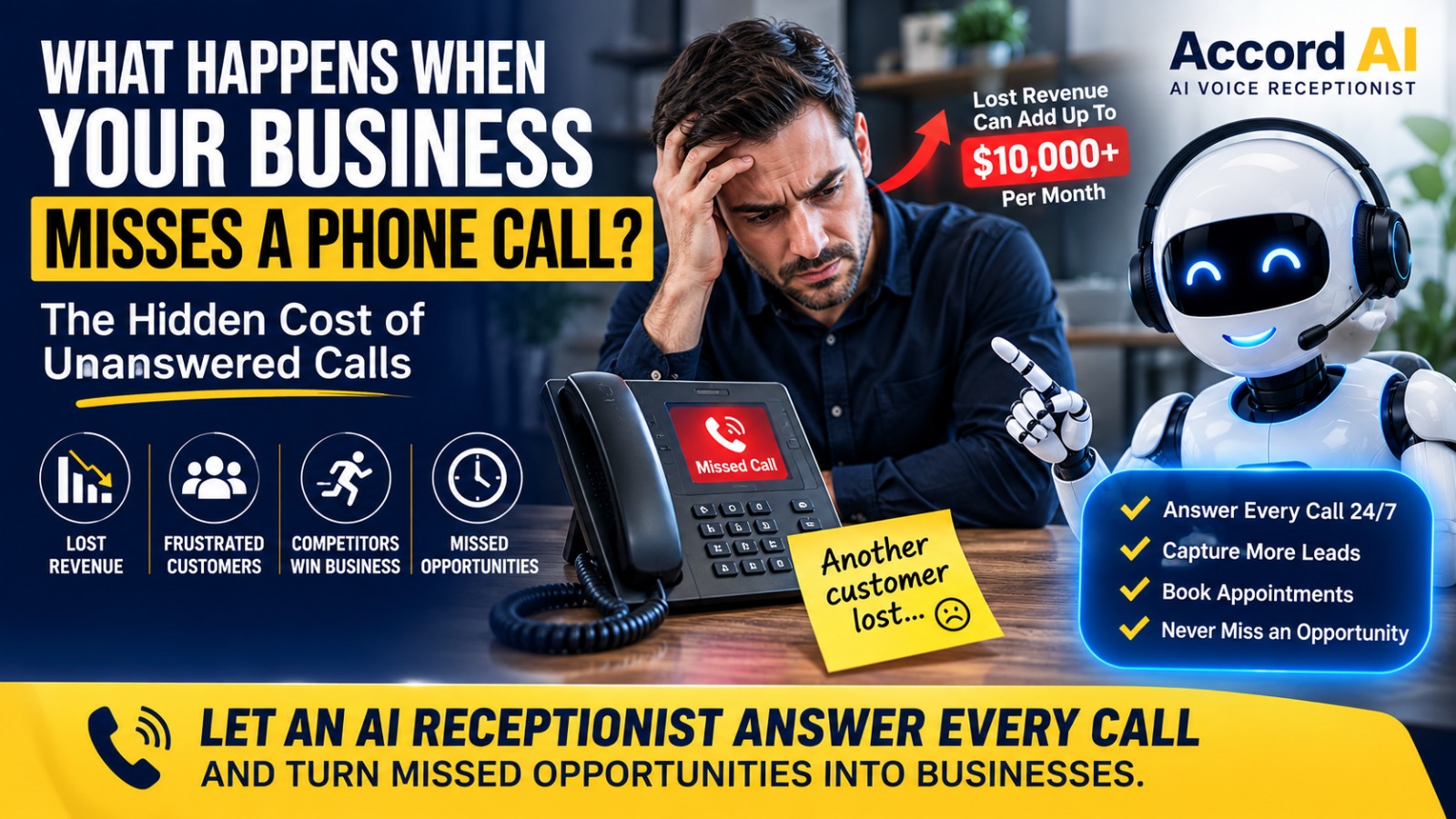
What If Your Next Missed Call Was Worth $10,000?
Your phone rings.
Nobody answers.
A potential customer waits for a few seconds, hears voicemail, and hangs up.
Then they call your competitor.
You may never know it happened.
There is no lost-customer notification. No email telling you that you missed a sale. No message saying that the caller was ready to book your service.
The opportunity simply disappears.
For many Australian businesses, missed phone calls are one of the most overlooked sources of lost revenue.
A business can spend thousands of dollars on advertising to generate leads, only to lose those leads because nobody was available to answer the phone.
And the problem isn't necessarily poor customer service.
Your team may simply be busy.
They could be serving another customer, attending a meeting, driving between appointments, working on a project, or dealing with another phone call.
But from the customer's perspective, the reason doesn't matter.
They called because they wanted help.
If nobody answers, they may move on.
This is where AI receptionists are changing the way Australian businesses handle customer communication.
Why Every Phone Call Matters
A phone call is different from many other forms of marketing.
When someone picks up their phone and calls your business, they've already taken action.
They may have:
- Seen your advertisement
- Visited your website
- Compared your business with competitors
- Read your reviews
- Found your Google listing
- Viewed your social media
- Been referred by an existing customer
The phone call may be the final step before they become a customer.
That's why answering the phone quickly can have a major impact on your ability to convert enquiries into business.
The Real Cost of a Missed Call
The cost of a missed call isn't simply the value of the phone conversation.
It's the potential value of the customer behind that call.
Consider a simple example.
A potential customer calls a professional service business about a $2,000 project.
Nobody answers.
The customer calls another company and becomes their client.
The business didn't just miss a phone call.
It potentially missed $2,000 in revenue.
Now imagine that happening several times a month.
Five missed opportunities could represent $10,000 in potential revenue.
Ten could represent $20,000.
The actual value will vary from business to business, but the principle remains the same:
A missed call can be much more expensive than it looks.
Why Customers Don't Always Leave Voicemails
Many businesses assume that an unanswered call isn't a serious problem because customers can simply leave a voicemail.
But customers don't always want to do that.
They may be:
- In a hurry
- Comparing multiple businesses
- Calling outside business hours
- Unsure whether they'll receive a callback
- Looking for immediate assistance
- Frustrated by previous experiences with voicemail systems
Instead of leaving a message, they may simply call another business.
In a competitive market, convenience matters.
The business that answers first can have a significant advantage.
The Problem With "We'll Call Them Back"
Returning missed calls is better than ignoring them.
But it isn't always enough.
Imagine someone calls your business at 10:30 AM.
Your team is busy.
You return the call at 1:00 PM.
The customer has already spoken with two competitors.
They may have already booked an appointment.
Your callback came too late.
Speed matters because customers often contact multiple businesses at once.
The longer you wait, the greater the possibility that the customer has already moved on.
What Happens When Your Team Is Already Busy?
This is one of the biggest challenges for growing businesses.
You may have an excellent team, but there are only so many calls they can answer simultaneously.
Imagine your receptionist is already speaking with a customer when another call comes in.
The second caller waits.
Then a third call arrives.
Eventually, someone may reach voicemail.
This isn't a staffing problem that can always be solved by simply telling employees to answer faster.
There is a limit to how many conversations one person can manage at once.
This is where automation can help.
How an AI Receptionist Changes the Equation
An AI receptionist can answer incoming calls automatically and have natural conversations with customers.
Instead of sending a caller to voicemail, it can immediately ask:
"Hello, thanks for calling. How can I help you today?"
The caller can explain what they need in normal conversational language.
The AI can then determine what action is required.
For example, it could:
- Answer a common question
- Book an appointment
- Capture a lead
- Collect contact details
- Qualify an enquiry
- Transfer the call
- Take a detailed message
- Provide approved business information
This means your team doesn't have to personally answer every routine call.
1. Answer Every Call
The most obvious benefit is also one of the most important.
An AI receptionist can answer calls 24 hours a day, 7 days a week.
That means customers don't have to wait until the next business day to receive an initial response.
Your business remains available:
- During business hours
- After hours
- On weekends
- During public holidays
- During staff breaks
- During busy periods
Instead of asking customers to leave a voicemail, you can provide immediate assistance.
2. Capture Leads While They're Hot
A lead is most valuable when the customer's interest is high.
An AI receptionist can collect important information during the initial conversation.
For example:
- Customer name
- Phone number
- Email address
- Service required
- Preferred appointment time
- Location
- Relevant enquiry details
This information can then be passed to your team or integrated into your CRM.
Your staff can follow up with an informed conversation instead of starting from scratch.
3. Book Appointments Automatically
For appointment-based businesses, phone calls often lead directly to bookings.
An AI receptionist can connect with appropriate calendar or booking systems to help customers:
- Book appointments
- Reschedule appointments
- Cancel appointments
- Check availability
- Receive confirmations
This can eliminate significant amounts of repetitive administrative work.
More importantly, customers can book when they are ready rather than waiting for someone to become available.
4. Handle Frequently Asked Questions
Not every phone call requires a human employee.
Customers often ask simple questions such as:
- What are your opening hours?
- Where are you located?
- What services do you provide?
- Do you offer consultations?
- How can I book an appointment?
- What areas do you service?
An AI receptionist can answer approved frequently asked questions instantly.
This allows your employees to spend more time handling conversations that genuinely require human involvement.
5. Route Important Calls to the Right Person
AI doesn't have to handle every conversation from beginning to end.
Sometimes the best solution is to connect the customer with a human.
An AI receptionist can identify the reason for the call and route it accordingly.
For example:
A sales enquiry can go to the sales team.
An existing customer can be transferred to support.
A billing question can be directed to accounts.
A complex enquiry can go directly to an appropriate staff member.
This creates a hybrid experience where AI handles speed and efficiency while humans handle situations requiring judgement and personal attention.
6. Reduce Pressure on Your Team
Constant phone interruptions can make employees less productive.
Imagine an employee working on an important task when the phone rings.
They stop.
They answer.
They spend five minutes handling a routine enquiry.
Then they return to their original task.
A few minutes later, the phone rings again.
Over an entire day, these interruptions can add up.
An AI receptionist can handle routine conversations, allowing your team to concentrate on higher-value work.
7. Provide a Better Customer Experience
Customers don't necessarily want to speak with a human every time.
What they want is to get their problem solved.
If an AI receptionist can answer their question immediately or book their appointment in seconds, that can be a better experience than waiting several minutes for someone to become available.
The ideal customer experience is therefore not necessarily:
Human versus AI.
It's:
The right response at the right time.
AI can provide immediate assistance, while humans remain available when their expertise is needed.
Which Businesses Can Benefit?
Almost any business that relies on phone enquiries can benefit from reducing missed calls.
Examples include:
- Medical clinics
- Dental practices
- Real estate agencies
- Law firms
- Accounting firms
- Mortgage brokers
- Education providers
- Trades businesses
- Cleaning companies
- Automotive businesses
- Property management companies
- Financial services
- Hospitality businesses
- Professional services
- Home service businesses
The more valuable your phone enquiries are, the more important it becomes to ensure those calls are handled effectively.
The New Standard for Customer Communication
Customers are becoming increasingly accustomed to instant communication.
They can order products instantly.
They can book hotels from their phones.
They can schedule appointments online.
They can chat with businesses at any time.
As expectations change, businesses that remain difficult to reach risk falling behind.
Being available isn't just about convenience.
It's becoming part of the customer experience.
AI Doesn't Have to Replace Your Team
One of the biggest misconceptions about AI receptionists is that businesses need to choose between AI and employees.
They don't.
A better approach is often to use AI as the first point of contact and humans when human expertise is needed.
AI can handle:
- Routine enquiries
- Appointment booking
- Lead capture
- FAQs
- Call routing
- After-hours calls
Your team can focus on:
- Complex enquiries
- Customer relationships
- Sales
- Problem solving
- High-value conversations
- Face-to-face service
The result is a more efficient division of work.
Frequently Asked Questions
How much can a business lose from missed calls?
There is no universal figure because it depends on the value of each customer and the business's conversion rate. However, even a small number of missed high-value enquiries can represent significant lost revenue.
Can an AI receptionist answer calls after hours?
Yes. AI receptionists can operate 24/7, allowing businesses to handle customer enquiries outside normal operating hours.
Can AI book appointments?
Yes. When integrated with compatible booking or calendar systems, an AI receptionist can help customers book, reschedule, and cancel appointments.
Can an AI receptionist transfer calls to employees?
Yes. AI can identify the purpose of a call and transfer the customer to the appropriate team member when human assistance is required.
Is an AI receptionist suitable for small businesses?
Yes. Small businesses can benefit significantly because they often have limited staff and cannot afford to have someone dedicated to answering calls throughout the day.
Does an AI receptionist replace human employees?
Not necessarily. Many businesses use AI alongside their existing staff to automate repetitive tasks while allowing employees to focus on more complex and valuable interactions.
Final Thoughts
Your next missed call could be a customer.
It could be a booking.
It could be a new client.
It could be a major business opportunity.
And the hardest part is that you'll probably never know what you lost.
You won't receive a notification saying:
"This customer would have chosen your business if someone had answered."
You'll simply see that the phone rang and nobody picked up.
AI receptionists give businesses a way to change that.
By answering calls instantly, capturing leads, booking appointments, handling routine enquiries, and transferring important conversations to your team, AI can help ensure that opportunities don't disappear simply because nobody was available to answer the phone.
The goal isn't to replace the human side of your business.
It's to make sure your customers can reach it.
Don't Let Your Next Customer Reach Your Competitor First
Your marketing gets people to your website.
Your website gets them to pick up the phone.
What happens next can determine whether you win the customer.
With Accord AI, your business can have an intelligent AI receptionist answering calls 24/7, capturing enquiries, booking appointments, and connecting customers with your team when needed.
Don't let your next customer become your competitor's customer simply because you couldn't answer the phone.
Contact Accord AI today to discover how an AI receptionist can help your business capture more opportunities and deliver a better customer experience.