AI Voice Agents vs Traditional Phone Systems: Which Is Better for Your Business?
Introduction
Your phone system might be costing you customers without you even realising it.
A customer calls your business.
The line is busy.
They wait.
Nobody answers.
They leave a voicemail- or more commonly, they hang up and call someone else.
For decades, traditional business phone systems have been the standard way companies handle customer calls. They connect callers to employees, provide voicemail, and often use automated menus to direct customers to different departments.
But customer expectations have changed.
People want immediate answers. They don't want to wait on hold, navigate complicated phone menus, or leave messages and hope someone calls them back.
This is where AI voice agents are changing business communication.
An AI voice agent can answer calls, understand natural language, respond conversationally, capture customer information, book appointments, qualify leads, answer frequently asked questions, and transfer calls to the right person.
So, which is better?
Traditional phone systems or AI voice agents?
The answer depends on your business, but for companies looking to improve customer experience, reduce missed calls, and automate routine conversations, AI voice technology offers significant advantages.
In this guide, we'll compare AI voice agents with traditional phone systems and explain what businesses should consider before making the switch.
What Is a Traditional Business Phone System?
A traditional phone system is designed primarily to connect callers with people within an organisation.
Depending on the system, it may include:
- Business phone numbers
- Call forwarding
- Voicemail
- Hold functions
- Call transfers
- Automated menus
- Extensions
- Conference calling
- Call recording
These systems have served businesses well for decades.
However, most traditional phone systems are fundamentally communication tools.
They connect people.
They don't necessarily understand what the caller wants or complete tasks for them.
What Is an AI Voice Agent?
An AI voice agent is an intelligent conversational system capable of communicating with customers over the phone.
Instead of simply connecting a caller to an employee, an AI voice agent can understand the conversation and take action.
For example, a customer might say:
"I need to book an appointment for next Tuesday afternoon."
The AI can understand the request, check availability, book the appointment, and confirm the details.
A traditional phone system would generally require the customer to navigate a menu or speak with an employee to accomplish the same task.
AI voice agents combine speech recognition, artificial intelligence, natural language processing, and realistic voice technology to create a more conversational experience.
How Traditional Phone Systems Work
A traditional phone system generally follows a predefined structure.
For example:
"Thank you for calling. Press 1 for sales. Press 2 for support. Press 3 for accounts."
The customer chooses an option and is routed accordingly.
This approach works well when customers know exactly which department they need.
However, real conversations aren't always that simple.
A customer may have a question that doesn't fit neatly into one category.
They may need information from multiple departments.
They may not know which option to choose.
AI voice agents take a different approach.
Instead of forcing customers through a menu, they allow callers to explain what they need naturally.
For example:
"I'm calling because I saw your website and I'd like to know whether you have appointments available this Friday."
The AI can understand the intent and respond appropriately.
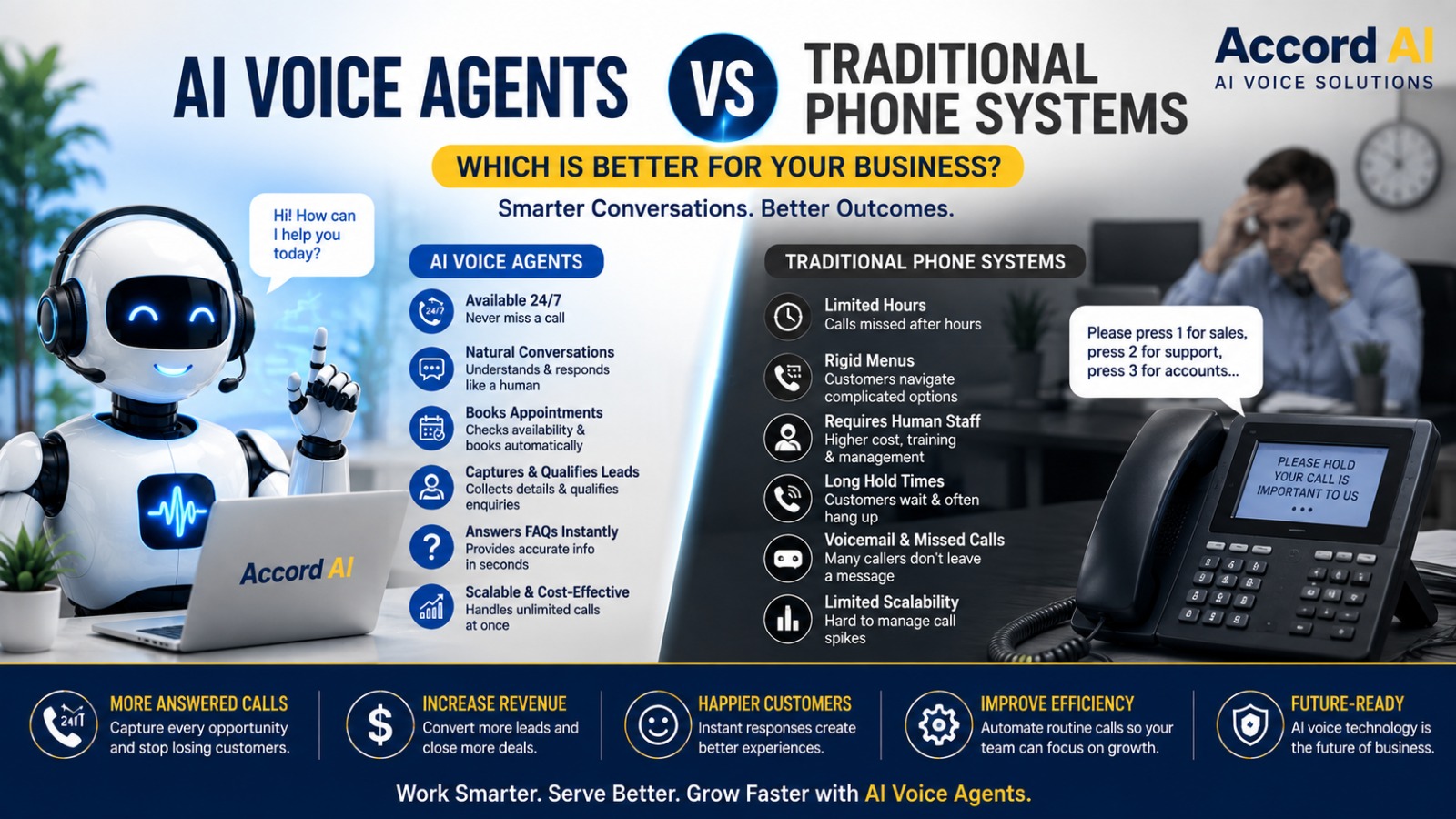
AI Voice Agents vs Traditional Phone Systems
The biggest difference is intelligence.
A traditional phone system follows predefined instructions.
An AI voice agent can understand and respond to conversations.
Traditional systems are primarily designed to route calls.
AI voice agents can actually handle tasks.
Let's look at the differences in more detail.
Customer Experience
Traditional Phone System
Customers often have to:
Listen to menu options
Press numbers
Wait for transfers
Leave voicemails
Wait for callbacks
This can create frustration, particularly when the customer has a simple question.
AI Voice Agent
Customers can speak naturally.
They don't necessarily need to know which department they need.
They can simply explain their problem and let the AI determine the appropriate response.
This creates a more conversational and convenient experience.
24/7 Availability
Traditional phone systems are usually connected to employees who operate during specific business hours.
Outside those hours, callers may receive:
- Voicemail
- An automated message
- An after-hours service
An AI voice agent can operate 24 hours a day, 7 days a week.
This means customers can receive assistance even when your office is closed.
For businesses receiving enquiries outside normal working hours, this can be a major advantage.
Call Handling Capacity
A traditional receptionist can generally handle one conversation at a time.
If five customers call simultaneously, some callers may have to wait.
If ten customers call, the problem becomes even greater.
AI voice agents can handle multiple conversations simultaneously.
This means your business can respond to increased call volumes without necessarily requiring additional reception staff.
Appointment Booking
Traditional phone systems usually require an employee to handle appointment bookings.
The employee needs to:
- Check the calendar
- Find an available time
- Enter the appointment
- Confirm details
- Notify the customer
An AI voice agent can automate much of this process.
When connected to the appropriate calendar or booking platform, it can check availability and book appointments during the conversation.
This can save significant administrative time.
Lead Qualification
Traditional phone systems don't usually qualify leads.
They simply connect callers with employees.
An AI voice agent can ask predefined questions to determine whether a caller is a suitable prospect.
For example:
"What service are you interested in?"
"When are you looking to get started?"
"What location are you based in?"
"What type of solution are you looking for?"
The information can then be passed to the sales team.
This means sales staff can spend more time speaking with qualified prospects.
Frequently Asked Questions
Many business calls involve simple questions.
Customers may ask:
What are your opening hours?
Where are you located?
What services do you provide?
Do you offer consultations?
How can I book an appointment?
Do you service my area?
An AI voice agent can answer approved FAQs instantly.
This reduces the number of repetitive calls handled manually by staff.
Call Transfers
AI doesn't need to handle every conversation itself.
Sometimes the best solution is to connect the customer with a human.
AI voice agents can identify the purpose of the call and transfer it to the appropriate team member.
For example:
Sales enquiry → Sales team
Technical issue → Support team
Billing question → Accounts team
Complex enquiry → Appropriate staff member
This creates a hybrid customer service model where AI handles routine tasks and humans handle situations requiring expertise or judgement.
Lead Capture
A traditional phone system may record that someone called.
An AI voice agent can capture meaningful information from the conversation.
For example:
Name
Phone number
Email address
Service required
Preferred appointment time
Location
Enquiry details
This information can then be transferred into your CRM or other business systems.
Instead of simply knowing that a call was missed, your business can know exactly what the customer wanted.
Scalability
Traditional phone systems depend heavily on people.
As call volumes increase, businesses may need additional staff.
AI voice agents scale differently.
A growing business can handle more conversations without necessarily increasing its reception team at the same rate.
This makes AI particularly useful for businesses experiencing rapid growth or seasonal increases in demand.
Consistency
Human employees can have different communication styles.
Their availability, workload, experience, and energy levels can also vary.
AI voice agents provide a consistent customer experience.
They can follow predefined business rules and approved information every time.
This is particularly useful for businesses that want to maintain consistent communication across large volumes of enquiries.
The Cost Difference
Cost is one of the biggest considerations for businesses evaluating AI voice technology.
A traditional receptionist involves more than salary.
Businesses may also need to consider:
- Superannuation
- Annual leave
- Sick leave
- Recruitment
- Training
- Payroll administration
- Office space
- Equipment
AI voice agents typically operate through a technology subscription and usage-based model.
The exact cost depends on factors such as:
- Call volume
- Call duration
- Features
- Integrations
- Customisation
- Number of phone lines
- Business requirements
Businesses should therefore compare the total cost of operating their existing phone system with the total cost of an AI solution.
The cheapest monthly option isn't necessarily the best option.
The important question is:
How much value can the system create?
What About Human Receptionists?
AI voice agents aren't necessarily designed to eliminate human employees.
In many businesses, the best solution is to combine AI with human staff.
AI can handle:
- Routine enquiries
- Appointment booking
- FAQs
- Lead capture
- Initial qualification
- After-hours calls
- Call routing
Humans can handle:
- Complex problems
- Sensitive conversations
- Negotiations
- Relationship building
- High-value sales
- Situations requiring judgement
This creates a more efficient division of responsibilities.
The AI handles volume.
The human handles complexity.
Which Businesses Can Benefit From AI Voice Agents?
AI voice technology can be used across a wide range of industries.
Examples include:
- Medical clinics
- Dental practices
- Real estate agencies
- Law firms
- Accounting firms
- Education providers
- Mortgage brokers
- Financial services
- Property management
- Trades businesses
- Automotive businesses
- Hospitality
- Professional services
- Customer support teams
The common factor is simple:
They receive phone calls that matter.
When Should You Consider Switching to AI?
An AI voice agent may be worth considering if your business experiences:
- Frequent missed calls
- High call volumes
- After-hours enquiries
- Repetitive questions
- Appointment booking workload
- Long wait times
- Reception staff overload
- Difficulty responding to leads quickly
- Rapid business growth
If your team is spending significant time answering repetitive calls, automation can provide immediate value.
How to Choose an AI Voice Agent
Not all AI voice solutions are the same.
Before choosing a provider, consider:
Natural Conversation
The AI should understand normal speech rather than forcing customers through rigid scripts.
Voice Quality
The voice should sound professional, natural, and appropriate for your brand.
Business Knowledge
The AI should be able to use accurate information about your services, policies, opening hours, and processes.
Integrations
Check whether the system can connect with your:
- CRM
- Calendar
- Booking system
- Customer database
- Communication tools
Call Transfer
The system should be able to transfer calls to humans when necessary.
Reporting
Look for useful analytics such as call volumes, transcripts, outcomes, and lead information.
Scalability
Your AI solution should be able to grow alongside your business.
Security and Privacy
Businesses should carefully evaluate how customer information is stored, processed, and protected.
The Future of Business Phone Systems
Traditional phone systems aren't disappearing overnight.
They remain useful for many businesses.
However, the role of the phone system is changing.
The future isn't simply about connecting a caller with an employee.
It's about understanding the caller and helping them complete what they need.
Imagine calling a business and saying:
"I'd like to book an appointment next Thursday."
Instead of pressing multiple buttons, waiting on hold, and speaking to a receptionist, you simply have a conversation.
The system understands you.
It checks availability.
It books the appointment.
It sends confirmation.
That's the direction business communication is heading.
Frequently Asked Questions
Can AI voice agents replace traditional phone systems?
AI voice agents can replace or significantly reduce the need for traditional call-handling processes, depending on the business. Many organisations use AI alongside their existing phone infrastructure.
Do AI voice agents sound like real people?
Modern voice AI can produce highly natural conversations with realistic voices and conversational responses.
Can AI voice agents transfer calls to humans?
Yes. AI can transfer calls when a customer needs human assistance or when predefined conditions are met.
Can AI book appointments?
Yes. With the appropriate calendar or booking integration, AI can manage appointment scheduling.
Can AI answer multiple calls at once?
Yes. AI voice systems can handle multiple conversations simultaneously, making them useful during high-volume periods.
Can AI voice agents work after hours?
Yes. One of their biggest advantages is continuous availability.
Are AI voice agents suitable for small businesses?
Yes. Small businesses can benefit significantly because AI can provide professional phone coverage without requiring a dedicated receptionist to be available at all times.
Final Thoughts
Traditional phone systems were designed for a world where connecting a caller to a person was the primary objective.
AI voice agents are designed for something different.
They can understand conversations, answer questions, perform tasks, capture information, and connect customers with the right people.
The choice isn't necessarily about replacing every traditional phone system or every receptionist.
It's about creating a smarter communication system.
For many Australian businesses, the combination of AI and human expertise can provide the best of both worlds: instant availability and automation when customers need simple assistance, combined with human expertise when conversations become complex.
The businesses that embrace this approach can reduce missed calls, improve response times, increase efficiency, and provide customers with a more convenient experience.
Your customers are already using technology to communicate with businesses.
The question is whether your business is ready to communicate with them on their terms.
Ready to Upgrade Your Business Phone Experience?
Your customers shouldn't have to wait for someone to answer.
With Accord AI, businesses can use intelligent AI voice receptionists to answer calls 24/7, capture leads, book appointments, answer common questions, and transfer customers to the right team member.
Instead of letting valuable calls go unanswered, give your business an intelligent first point of contact.
Contact Accord AI today to discover how AI voice technology can transform the way your business communicates with customers.