AI Receptionist vs Human Receptionist: Which Is Better for Australian Businesses?
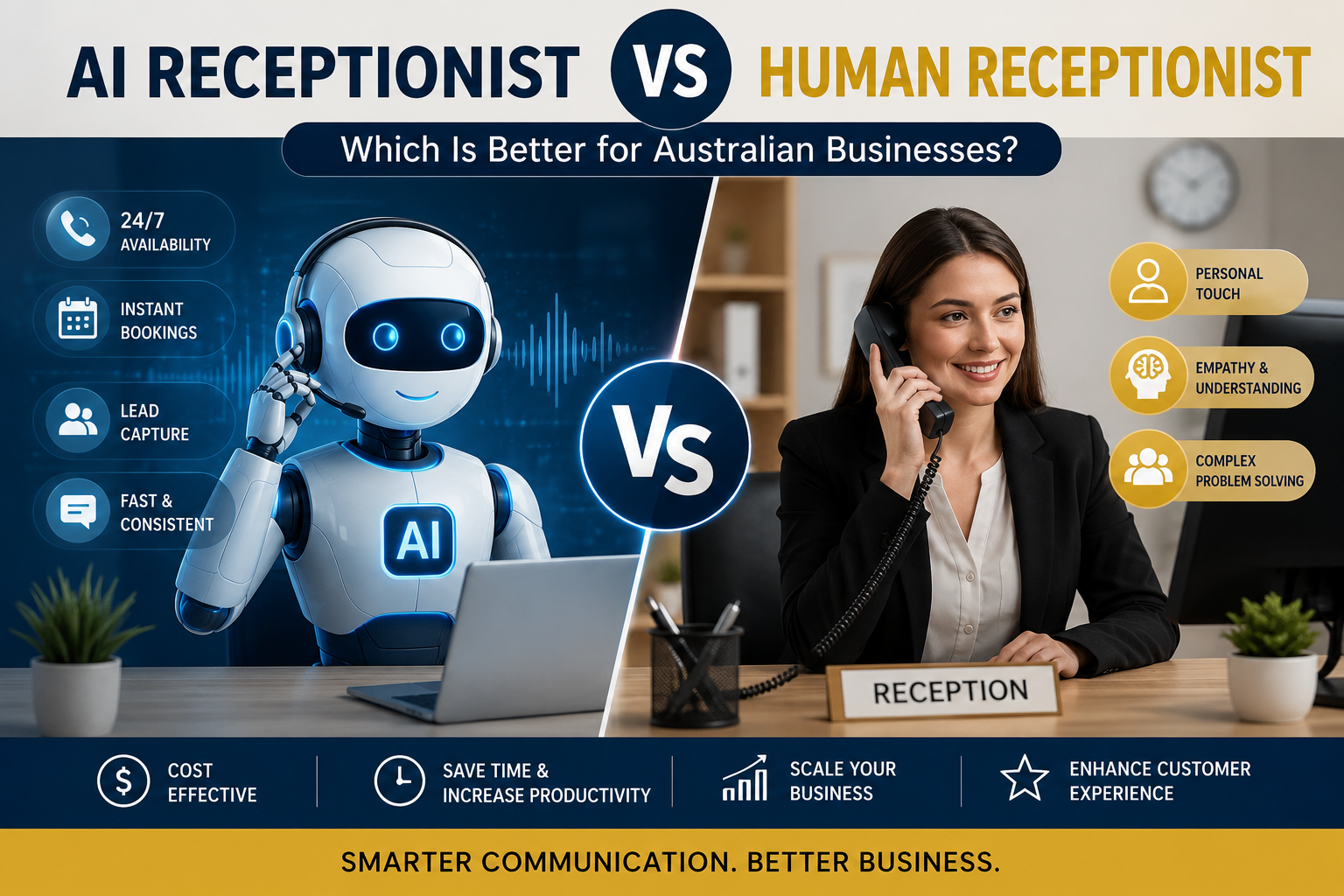
AI Receptionist vs Human Receptionist: Which Is Better for Australian Businesses?
As Australian businesses continue embracing digital transformation, one question is becoming increasingly common:
Should you hire a traditional receptionist or invest in an AI receptionist?
For decades, receptionists have been the face and voice of businesses, greeting customers, answering phone calls, booking appointments, and ensuring smooth daily operations. However, advances in artificial intelligence have introduced a new alternative that is changing the way businesses communicate with their customers.
AI receptionists are no longer simple automated phone systems. They are intelligent virtual assistants capable of understanding natural conversations, answering customer enquiries, booking appointments, qualifying leads, transferring calls, and integrating with business software—all while operating 24 hours a day, 7 days a week.
This doesn't necessarily mean AI is replacing human receptionists. Instead, many organisations are discovering that the right balance between automation and human expertise leads to better customer experiences, lower operating costs, and increased efficiency.
In this guide, we'll compare AI receptionists and traditional receptionists across every important area, helping Australian businesses determine which solution best suits their needs.
Understanding the Role of a Receptionist
Before comparing the two, it's important to understand what a receptionist actually does.
A receptionist is often the first point of contact between a business and its customers. Their responsibilities extend far beyond simply answering phone calls.
Typical receptionist duties include:
- Greeting customers and visitors
- Answering incoming phone calls
- Scheduling appointments
- Responding to customer enquiries
- Taking messages
- Directing calls to the correct department
- Managing calendars
- Processing bookings
- Handling administrative tasks
- Providing information about products and services
A good receptionist creates a positive first impression and plays a critical role in customer satisfaction.
What Is an AI Receptionist?
An AI receptionist performs many of the same responsibilities as a traditional receptionist, but instead of being a person sitting at a front desk, it uses advanced artificial intelligence to communicate with customers.
Unlike older automated phone systems that rely on pre-recorded menus, an AI receptionist understands natural language and responds conversationally.
For example, rather than asking callers to press multiple numbers, an AI receptionist can understand requests such as:
"I'd like to make an appointment for Friday afternoon."
or
"Can you tell me your business hours?"
The AI immediately understands the customer's intent and provides the appropriate response without requiring complicated menu navigation.
Modern AI receptionists can also integrate with calendars, customer relationship management (CRM) systems, booking platforms, payment systems, and business databases, allowing them to complete tasks automatically.
Traditional Receptionist: Strengths and Challenges
Human receptionists remain an important part of many businesses, particularly those that require face-to-face interaction and personalised customer service.
Advantages of a Human Receptionist
Personal Connection
People naturally connect with other people. Human receptionists can build relationships, recognise returning customers, and create memorable customer experiences through empathy and emotional intelligence.
Complex Problem Solving
When customers present unusual situations or emotional concerns, human judgement is often invaluable.
Receptionists can adapt to unexpected conversations in ways that AI still finds challenging.
In-Person Customer Service
Businesses that regularly welcome visitors—such as medical clinics, hotels, legal offices, and government organisations—often require someone physically present to greet guests, manage reception areas, and assist customers.
Emotional Intelligence
Humans can recognise frustration, excitement, uncertainty, or urgency through subtle conversational cues and body language.
This allows experienced receptionists to respond with empathy and understanding.
Challenges of a Human Receptionist
Despite these strengths, employing a receptionist also comes with several challenges.
Limited Working Hours
A receptionist typically works during standard business hours.
Calls received after hours, on weekends, or during public holidays often go unanswered.
Higher Operating Costs
Employing staff involves much more than salary.
Businesses must also consider:
Superannuation
Annual leave
Sick leave
Payroll tax
Recruitment costs
Training expenses
Office equipment
Workspace requirements
These expenses can significantly increase the total cost of employment.
Busy Periods
Receptionists can only handle one conversation at a time.
During busy periods, customers may experience long wait times or abandoned calls.
Staff Turnover
Recruitment, onboarding, and training require both time and financial investment.
High staff turnover can affect customer experience and operational consistency.
What Makes AI Receptionists Different?
An AI receptionist isn't simply a digital answering machine.
Modern AI systems use advanced conversational intelligence that allows them to understand customer intent, respond naturally, and complete real business tasks.
Unlike traditional receptionists, AI can:
Answer every incoming call instantly
Handle hundreds of conversations simultaneously
Operate continuously without breaks
Book appointments automatically
Capture every lead
Transfer calls intelligently
Answer frequently asked questions
Send SMS and email confirmations
Integrate with business software
Provide multilingual support
Generate call transcripts automatically
Because AI never becomes tired or overwhelmed, customers receive the same consistent level of service regardless of call volume.
The Biggest Difference
The biggest difference between a human receptionist and an AI receptionist isn't simply technology.
It's availability.
A traditional receptionist is generally available only during working hours and can assist one caller at a time.
An AI receptionist can answer every call, at any time of the day or night, while simultaneously helping multiple customers without placing anyone on hold.
For businesses that receive enquiries outside office hours or experience high call volumes, this can dramatically improve customer satisfaction and reduce missed opportunities.
Cost Comparison
For most businesses, cost is one of the biggest factors when deciding between hiring a receptionist and implementing an AI receptionist.
While a traditional receptionist provides valuable in-person support, employing staff comes with ongoing expenses that extend far beyond salary.
Typical employment costs include:
Salary or hourly wages
Superannuation
Annual leave
Sick leave
Payroll tax
Recruitment expenses
Training costs
Office space and equipment
Employee benefits
These costs can add up significantly over time.
An AI receptionist, on the other hand, usually operates on a monthly subscription model. There are no annual leave entitlements, sick leave, overtime payments, or recruitment costs.
For businesses with growing call volumes, AI often delivers a lower total cost of ownership while maintaining consistent customer service.
Availability
One of the greatest advantages of an AI receptionist is its ability to operate around the clock.
Human Receptionist
Available during business hours
Takes lunch breaks
Requires annual leave
Requires sick leave
Cannot answer calls after hours
Handles one caller at a time
AI Receptionist
Available 24 hours a day
Operates every day of the year
Never takes breaks
Never calls in sick
Answers after-hours enquiries
Handles multiple callers simultaneously
For businesses that receive enquiries in the evenings, weekends, or public holidays, this can make a significant difference in customer satisfaction and revenue.
Customer Experience
Many business owners initially worry that customers may prefer speaking with a human.
While human interaction remains important in many situations, modern AI has significantly improved the customer experience.
Today's AI receptionists understand natural language, respond conversationally, and provide immediate assistance without long wait times.
Customers often value:
Faster responses
Immediate answers
Shorter wait times
Consistent service
Quick appointment booking
A human receptionist may provide greater empathy during emotionally sensitive conversations, but AI excels at handling routine enquiries quickly and efficiently.
For many businesses, customers appreciate getting immediate assistance rather than waiting for someone to become available.
Appointment Booking
Managing appointments is one of the most time-consuming responsibilities for reception staff.
Traditional receptionists manually:
Check calendars
Find available times
Confirm appointments
Send reminders
Reschedule bookings
An AI receptionist can automate this entire process.
When connected to Google Calendar, Microsoft Outlook, or your booking software, AI can:
Check availability instantly
Book appointments automatically
Reschedule bookings
Cancel appointments
Send confirmation emails
Send SMS reminders
Customers receive immediate confirmation without waiting for staff to become available.
Lead Capture
Every missed phone call represents a potential lost customer.
Human receptionists perform an excellent job of capturing leads during working hours, but calls received after hours may be missed.
An AI receptionist ensures every enquiry is recorded.
It can automatically collect:
Customer name
Phone number
Email address
Business name
Reason for calling
Service required
Preferred appointment time
This information can be sent directly into your CRM, allowing your sales team to follow up quickly.
No lead is forgotten or misplaced.
Productivity
Businesses don't hire receptionists simply to answer phones.
Receptionists also manage administrative work, calendars, paperwork, emails, customer enquiries, and countless daily tasks.
During busy periods, answering calls can interrupt these responsibilities.
AI removes much of this repetitive workload.
Instead of spending hours answering routine questions, your team can focus on:
Customer relationships
Sales
Business development
Problem solving
High-value administrative work
This improves overall workplace productivity while reducing stress on staff.
Scalability
Business growth usually means increased call volumes.
With a traditional receptionist, more calls often require:
Hiring additional staff
Larger office space
Increased payroll
Additional training
AI scales almost instantly.
Whether your business receives 20 calls a day or 500, the system can continue answering conversations without increasing staffing requirements.
This makes AI particularly attractive for rapidly growing businesses.
AI receptionists can deliver value across almost every industry.
Businesses seeing the greatest benefits include:
Medical clinics
Dental practices
Real estate agencies
Law firms
Accounting firms
Education providers
Mortgage brokers
Financial advisers
Restaurants
Hotels
Property management companies
Electricians
Plumbers
Builders
Automotive workshops
Professional service firms
Any organisation receiving regular phone enquiries can benefit from faster response times and improved customer service.
Can AI and Human Receptionists Work Together?
One of the biggest misconceptions is that businesses must choose between AI and people.
In reality, the most successful organisations combine both.
For example:
During business hours:
AI answers every incoming call immediately.
Routine enquiries are handled automatically.
Complex calls are transferred to staff.
After business hours:
AI continues answering every call.
Appointments are booked automatically.
Leads are captured.
Emergency calls are escalated when required.
This hybrid approach provides customers with immediate assistance while allowing employees to focus on situations where human judgement adds the greatest value.
Final Verdict
Choosing between an AI receptionist and a human receptionist isn't about deciding which one is universally better—it's about identifying which solution best aligns with your business goals, customer expectations, and operational needs.
If your business depends on face-to-face customer interactions throughout the day, a human receptionist remains an invaluable asset. Their emotional intelligence, adaptability, and personal touch create meaningful customer relationships that technology cannot fully replicate.
However, if your business regularly receives phone enquiries, appointment requests, after-hours calls, or repetitive questions, an AI receptionist can significantly improve efficiency while reducing administrative workload.
For many Australian businesses, the most effective solution isn't replacing people—it's combining the strengths of both.
An AI receptionist can answer every incoming call, manage routine enquiries, qualify leads, and schedule appointments, while human staff focus on complex customer interactions, problem-solving, and relationship building.
This combination creates a better customer experience while allowing your business to operate more efficiently.
Real-World Example
Imagine a busy dental clinic in Sydney.
Throughout the day, reception staff are welcoming patients, processing payments, coordinating appointments, and assisting visitors.
Meanwhile, the phone rings continuously.
Some callers want to:
Book an appointment
Reschedule a visit
Ask about opening hours
Confirm parking availability
Enquire about services
Speak with a dentist
During busy periods, calls may be placed on hold or sent to voicemail.
Now imagine introducing an AI receptionist.
The AI instantly answers every incoming call.
Routine questions are answered immediately.
Appointments are booked automatically.
Only calls requiring personal attention are transferred to reception staff.
Patients receive faster service, staff experience less pressure, and the clinic captures enquiries that might otherwise have been missed.
The result is a smoother experience for both customers and employees.
Frequently Asked Questions
Can an AI receptionist completely replace a human receptionist?
Not always.
Businesses requiring face-to-face customer service still benefit from having reception staff on-site. However, an AI receptionist can automate phone-based tasks such as answering enquiries, booking appointments, qualifying leads, and managing after-hours calls.
For many organisations, AI complements existing staff rather than replacing them.
Is an AI receptionist suitable for small businesses?
Absolutely.
Small businesses often have limited resources and cannot afford dedicated reception staff or extended business hours.
An AI receptionist enables even the smallest business to provide professional, around-the-clock customer service without significantly increasing operating costs.
Can customers tell they're speaking with AI?
Modern conversational AI has become remarkably natural.
Many callers simply appreciate receiving immediate assistance without waiting on hold.
Businesses can also choose to let callers know they are speaking with an AI assistant while assuring them they can be transferred to a team member whenever needed.
Can an AI receptionist book appointments?
Yes.
When connected to your calendar or booking software, an AI receptionist can:
Book appointments
Reschedule bookings
Cancel appointments
Check availability
Send confirmation emails
Send SMS reminders
This reduces administrative work while improving customer convenience.
Can AI answer multiple calls simultaneously?
Yes.
Unlike a traditional receptionist who can only assist one caller at a time, an AI receptionist can manage multiple conversations simultaneously without increasing wait times.
This is particularly valuable during busy periods.
Is customer information secure?
Reputable AI receptionist providers use encrypted communications, secure cloud infrastructure, and strict access controls to help protect customer information.
Businesses should choose providers that follow Australian privacy requirements and recognised security best practices.
Does an AI receptionist work after business hours?
Yes.
One of the biggest advantages of AI is continuous availability.
Whether a customer calls during the evening, on weekends, or during public holidays, the AI remains available to answer enquiries, capture leads, and book appointments.
The Future of Business Communication
Artificial intelligence is rapidly changing how businesses interact with customers.
Just as email transformed written communication and online booking systems replaced manual appointment books, AI receptionists are becoming the next evolution of customer service.
Rather than replacing people, AI allows employees to focus on higher-value work while automation handles repetitive administrative tasks.
Businesses that adopt AI early often gain several advantages, including:
Faster response times
Higher customer satisfaction
Reduced operational costs
Increased lead conversion
Better scalability
More efficient use of staff
As technology continues to improve, AI receptionists will become an increasingly common part of Australian businesses across every industry.
Final Thoughts
The debate between AI receptionists and human receptionists isn't about choosing one over the other.
It's about finding the right balance.
Human receptionists provide empathy, personal relationships, and in-person customer service that remain incredibly valuable.
AI receptionists provide speed, consistency, availability, and automation that modern businesses increasingly rely upon.
Together, they create a customer experience that is both personal and highly efficient.
For organisations looking to improve customer service, reduce missed calls, and increase productivity without compromising professionalism, an AI receptionist represents a smart investment in the future of business communication.